
Payment Gateway Business Vertical Classification
4 Mn
December 23, 2025
Author:
Garry
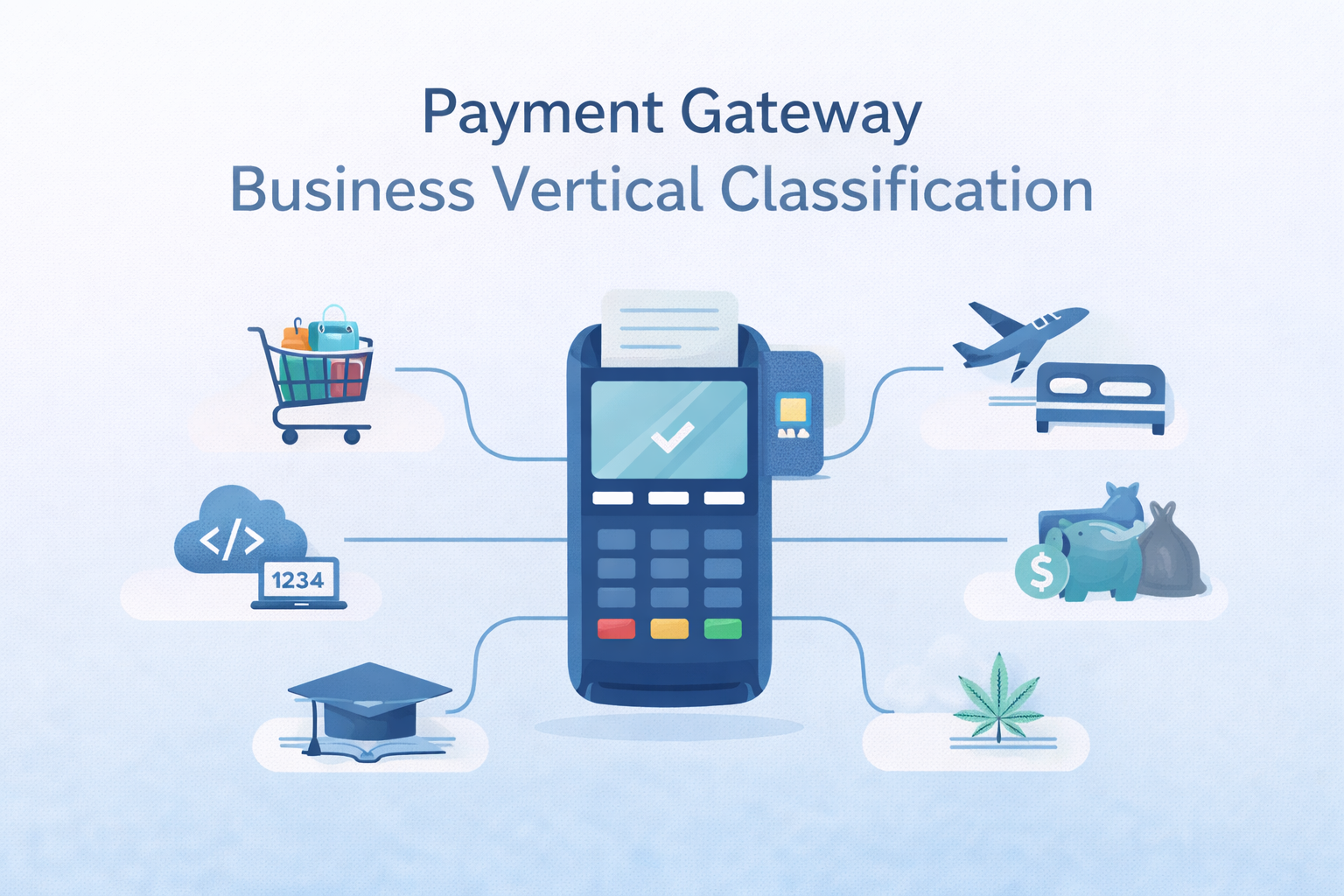

Business vertical classification is how a payment gateway identifies and categorizes a business before allowing it to process payments. Instead of focusing only on documents, gateways first assess what type of business is operating and the risk it carries.
Gateways group merchants into verticals such as e-commerce, SaaS, travel, gaming, crypto, adult, or CBD to meet banking and card network requirements. This classification directly affects approval decisions, fees, settlement speed, supported banks, payment methods, and compliance checks.
Importantly, classification is based on actual transaction behavior, not just how a business describes itself. Two similar businesses can receive very different treatment depending on billing structure, refunds, disputes, and regulatory exposure. From our experience at PayFirmly, many payment issues start with incorrect vertical classification, and when this is handled correctly from the beginning, long-term problems are often avoided.
Build a Payment Setup That Matches Your Business Model
From SaaS to high-risk industries, PayFirmly aligns your payment routing and gateway stack with how your business actually operates — not how it’s labeled.


Why Payment Gateways Must Classify Every Business
Payment gateways classify businesses because they are legally and financially required to. They sit between merchants, banks, card networks, and regulators, and if any layer flags a business as risky or non-compliant, the gateway becomes responsible.
Business vertical classification allows gateways to quickly understand risk exposure, compliance needs, and banking eligibility. Different industries show different patterns for chargebacks, refunds, and fraud, so gateways must know exactly what type of transactions are being processed.
This classification also determines:
- Which card network rules apply
- What level of KYC and monitoring is required
- Which banks are allowed to support the merchant
- Whether reserves or delayed settlements are needed
From our experience at PayFirmly, most merchant issues around fees, payouts, or sudden reviews trace back to decisions made during this early classification stage. This is why gateways cannot skip or simplify vertical classification, even for new or low-volume businesses.
Also Checkout: Payment Processor for Vapes & E-Cigarettes
Payment Gateway Business Vertical Classification Table
Above table gives a clear overview of how payment gateways classify different business verticals based on risk level. It shows how each vertical affects approval difficulty, payment controls, and common challenges merchants face. This helps businesses quickly understand where they fit and what to expect before applying for a payment gateway.
How Payment Gateways Determine a Business Vertical
Most merchants believe that their business vertical is decided by a single dropdown in the application form. In reality, that field is only a starting point. Payment gateways run a multi-layer review process to decide how your business is actually classified.
From what we see at PayFirmly, vertical determination is based on evidence, behavior, and risk signals, not just descriptions.
Website and product analysis
The first thing gateways review is your website. They look at:
- What exactly is being sold
- How pricing is structured
- Whether content is digital, physical, or service-based
- Refund, cancellation, and delivery policies
For example, a site claiming to be “software services” may be reclassified as subscription-based digital content if recurring billing, adult themes, or access-based pricing is detected.
Transaction flow and payment journey
Gateways analyze how money moves:
- One-time payments vs recurring subscriptions
- Immediate delivery vs delayed fulfillment
- Trial periods, free-to-paid conversions, or pre-orders
A travel booking site, for instance, is classified differently from a regular e-commerce store because services are delivered later, increasing refund and chargeback exposure.
Merchant Category Codes (MCC)
Behind the scenes, every merchant account is assigned an MCC. This code helps banks and card networks understand what industry the merchant operates in. While merchants rarely choose this directly, it plays a major role in vertical classification and risk scoring.
A mismatch between claimed business activity and assigned MCC often leads to:
- Account reviews
- Temporary holds
- Sudden terminations
Geographic exposure
Where your customers are located matters as much as what you sell. Gateways assess:
- Countries you operate in
- Sanctioned or high-risk regions
- Cross-border transaction ratios
The same business model can be treated as low-risk in one region and high-risk in another due to local regulations.
Historical and projected transaction behavior
If a business has existing processing history, gateways review:
- Chargeback ratios
- Refund frequency
- Average ticket size
- Monthly volume growth patterns
For new businesses, gateways rely on industry benchmarks. If your projections look aggressive compared to your vertical norms, classification may shift toward higher risk.
Third-party signals and compliance checks
Gateways also use external data sources:
- Watchlists and compliance databases
- Industry blacklists
- Previous account shutdown records
This is why reapplying with a different provider does not always reset the process. Vertical classification follows the business, not the gateway.
At PayFirmly, we often help businesses correct or refine their vertical classification before onboarding. When the classification matches the real business model from day one, approval rates improve, pricing becomes fairer, and long-term account stability increases.
Read Also: Adult Entertainment Payment Processing Services
Low-Risk Business Verticals and Why They Are Approved Easily
Low-risk business verticals are industries that payment gateways and banks understand well, trust historically, and see predictable behavior from. These businesses show stable transaction patterns, low chargeback ratios, clear delivery of goods or services, and minimal regulatory exposure. Because of this, approvals are faster and ongoing monitoring is lighter.
From what we observe at PayFirmly, low-risk does not mean no risk. It simply means the risk is known, measurable, and manageable for banks and card networks.
Common characteristics of low-risk verticals
Payment gateways usually place a business in a low-risk category when most of the following conditions are met:
- Physical or clearly defined digital products
- Immediate or near-immediate delivery
- Transparent pricing and refund policies
- Low dispute and fraud history across the industry
- No regulatory or content-related restrictions
These factors make it easier for banks to predict outcomes if something goes wrong.
Examples of typical low-risk business verticals
While classification can vary slightly between providers, low-risk verticals usually include:
- Standard e-commerce (fashion, electronics, household goods)
- SaaS tools with business users and clear value delivery
- Education platforms selling courses or certifications
- Professional services with invoicing models
- B2B software and enterprise tools
These industries rarely trigger card network scrutiny unless there is abnormal behavior.
Why approvals are faster for these businesses
Low-risk verticals benefit from:
- Fewer compliance checks during onboarding
- Minimal or no rolling reserves
- Faster settlement cycles
- Access to more acquiring banks
- Lower transaction fees
Banks already have strong historical data for these industries, so they do not require enhanced due diligence or manual risk approvals in most cases.
A common misconception
Many merchants assume that labeling their business as “software” or “e-commerce” will automatically place them in a low-risk category. In reality, gateways look at how the product is sold and delivered, not just what it is called.
For example, a SaaS tool offering transparent monthly billing to businesses is treated very differently from a consumer-facing subscription platform with trials, auto-renewals, and high refund rates. The vertical might sound similar, but the risk profile is not.
PayFirmly often see businesses that could qualify as low-risk but accidentally move themselves into medium-risk territory due to unclear website content, confusing billing flows, or poorly written policies. Fixing these details early often changes how the business is classified.
Medium-Risk Business Verticals and Common Processing Limits
Medium-risk business verticals sit between stable industries and high-risk categories. These businesses are usually legal and widely accepted, but they show patterns that increase refunds, disputes, or regulatory attention.
Gateways do not reject these verticals outright. Instead, they apply controls.
Typical medium-risk verticals
Common examples include:
- Subscription-based services
- Marketplaces and platforms
- Travel-related services with advance bookings
- Event ticketing and pre-orders
- Digital services sold to consumers
These models often involve delayed fulfillment, recurring billing, or third-party sellers.
Why gateways treat them cautiously
The main concerns are:
- Higher refund and cancellation rates
- Customer confusion around billing
- Responsibility split between platform and sellers
- Delivery happening weeks or months after payment
Even when businesses are legitimate, these factors increase financial exposure for banks.
Common limits applied
Most medium-risk merchants face:
- Partial rolling reserves
- Monthly or daily volume caps
- Slower settlement cycles
- Extra monitoring during early months
These limits usually reduce over time if performance remains stable.
Many medium-risk businesses move closer to low-risk treatment once payment flows, policies, and dispute handling are properly structured.
High-Risk Business Verticals Explained Clearly
High-risk business verticals are industries where payment gateways face higher financial, regulatory, or reputational exposure. These businesses are not illegal, but they require special approval, stronger controls, and the right banking partners.
Gateways classify a business as high-risk when disputes, refunds, fraud, or compliance issues occur more frequently across the industry, not just for one merchant.
Common high-risk verticals
Typical examples include:
- Adult and explicit content platforms
- Gaming, betting, and gambling services
- Crypto-related products and exchanges
- CBD, cannabis, and regulated wellness products
- Travel and tourism with delayed fulfillment
- Forex, trading, and investment platforms
- Subscription-heavy consumer platforms
These industries operate under stricter card network and banking rules.
Why these verticals are treated differently
The main reasons are:
- Higher chargeback ratios
- Regulatory scrutiny in multiple countries
- Content or product restrictions
- Delayed delivery of services
- Greater risk of customer disputes
Even well-run businesses in these sectors are affected by industry-wide risk history.
What this means for merchants
High-risk classification usually results in:
- Manual approval instead of instant onboarding
- Rolling reserves and longer settlements
- Fewer supported banks and processors
- Higher monitoring and compliance checks
Conclusion
Business vertical classification is not a technical formality or a checkbox in a payment application. It is the core decision layer that shapes how a business is approved, priced, monitored, and supported over time. Whether a company falls into low-risk, medium-risk, or high-risk categories directly impacts approval speed, fees, settlement timelines, and long-term account stability.
Most payment issues merchants face—rejections, rolling reserves, payout delays, or sudden account reviews—start with incorrect or misunderstood vertical classification. When businesses clearly align their model, transaction flow, and compliance posture with the right vertical from day one, many of these problems never appear.
At PayFirmly, we approach business vertical classification as a strategic step, not a compliance obstacle. By matching each business with the right processors, banks, and routing logic based on its true vertical, we help merchants build payment setups that are stable, scalable, and designed to last.
Get Your Business Classified Correctly From Day One
Avoid declines, account freezes, and hidden restrictions caused by incorrect vertical classification. PayFirmly helps match your business to the right payment gateways, banks, and risk category from the start.
Other Related Articles

October 14, 2025
How to Start a Payment Processing Company?


Secure Crypto Payment Orchestration & Processor with PayFirmly
The future of adult payment processing is intelligent, compliant, and built around you.
Join leading adult brands using PayFirmly to boost approvals, cut fees, and simplify multi-processor management — all from one secure dashboard.
